
Genealogy · Village history · AI import
More than a family tree: a database of family, house and village history
Show the same data as a family tree, a timeline, a map or the history of a house and village. Transcribe parish registers with AI — faster, but optional.
- ✓ People, houses and organizations
- ✓ Timelines
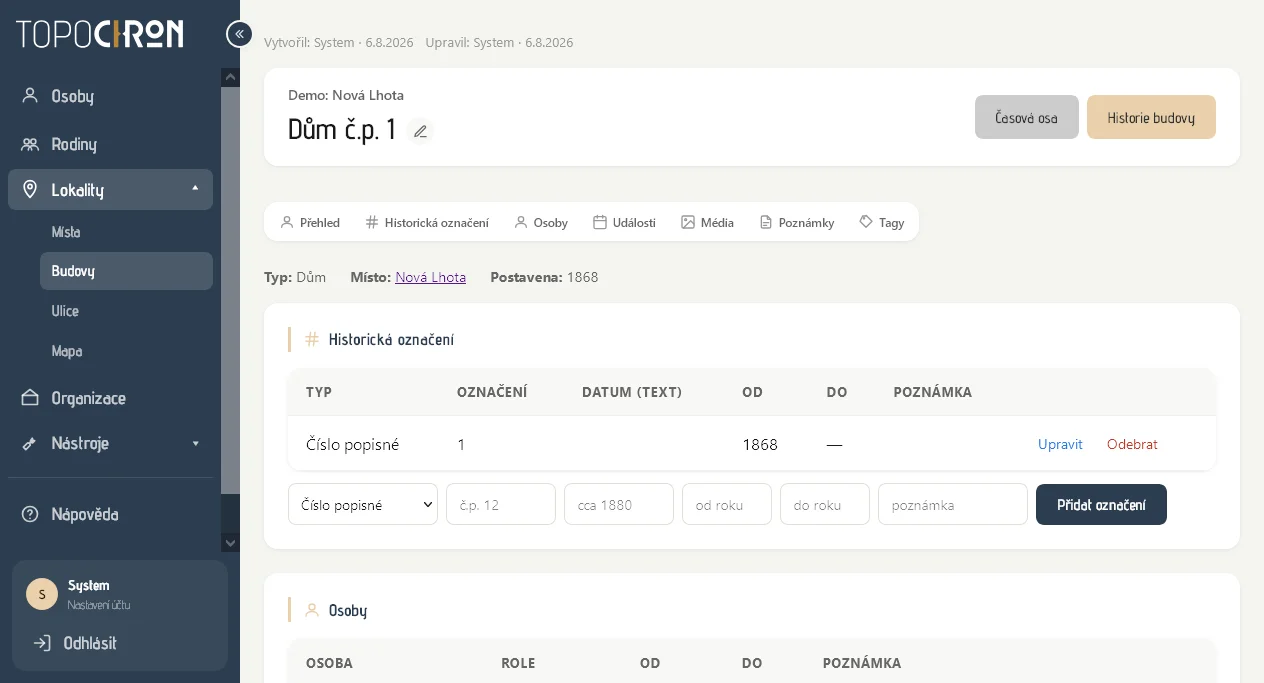
- ✓ Historic buildings and associations
- ✓ AI import of parish registers
- ✓ Interactive maps with historical layers
- ✓ Citations of archival sources
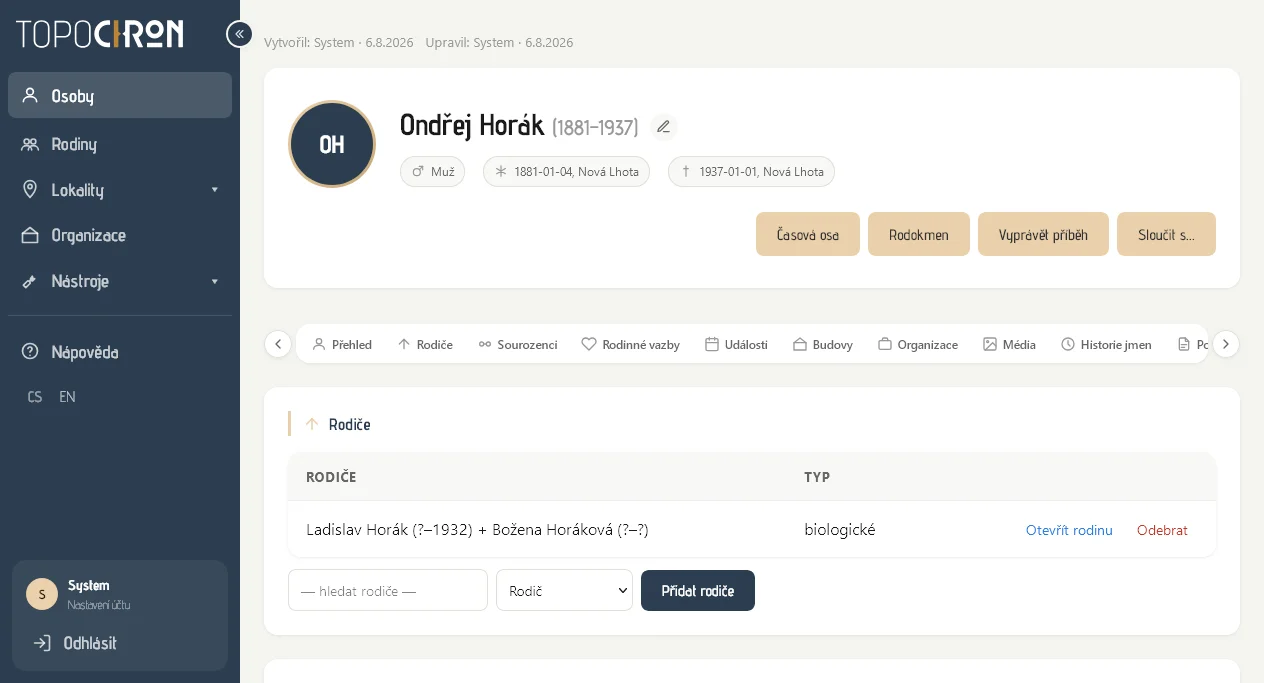
One connected database
The family tree is just one view
Show the same people, families and events in different ways as needed — and it is still one connected database, not six separate tools.
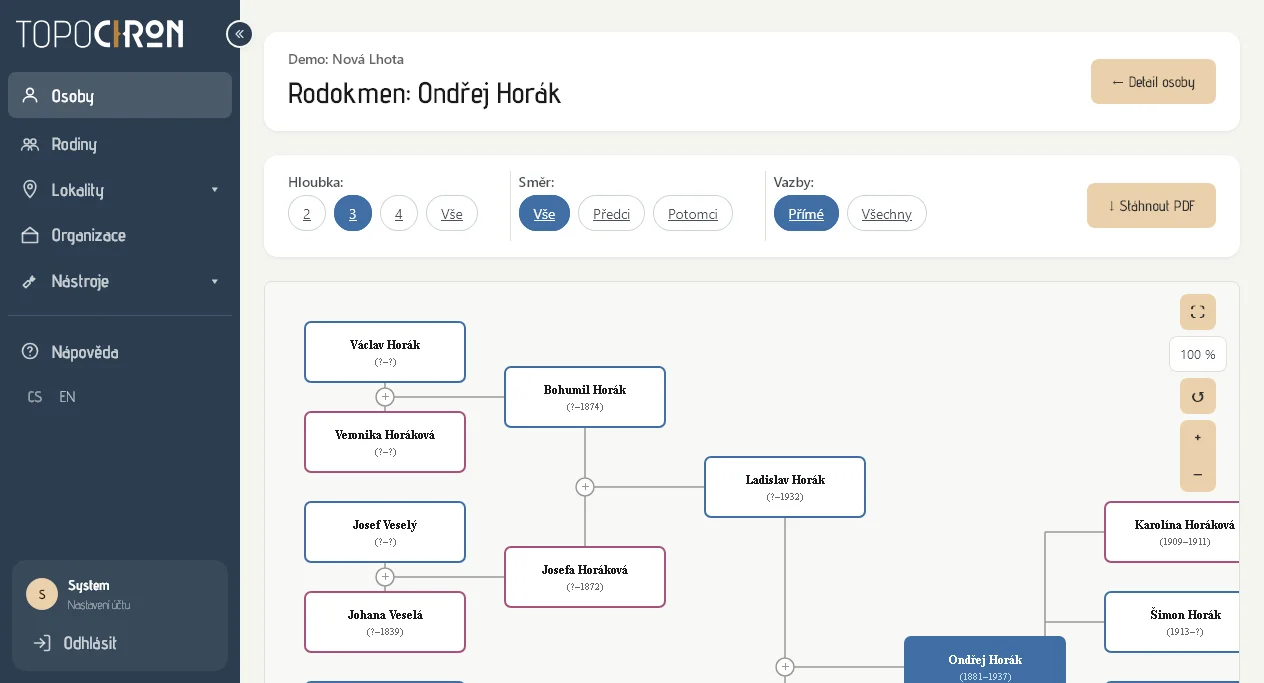
Family tree
A tree of ancestors and descendants, interactive and clear.
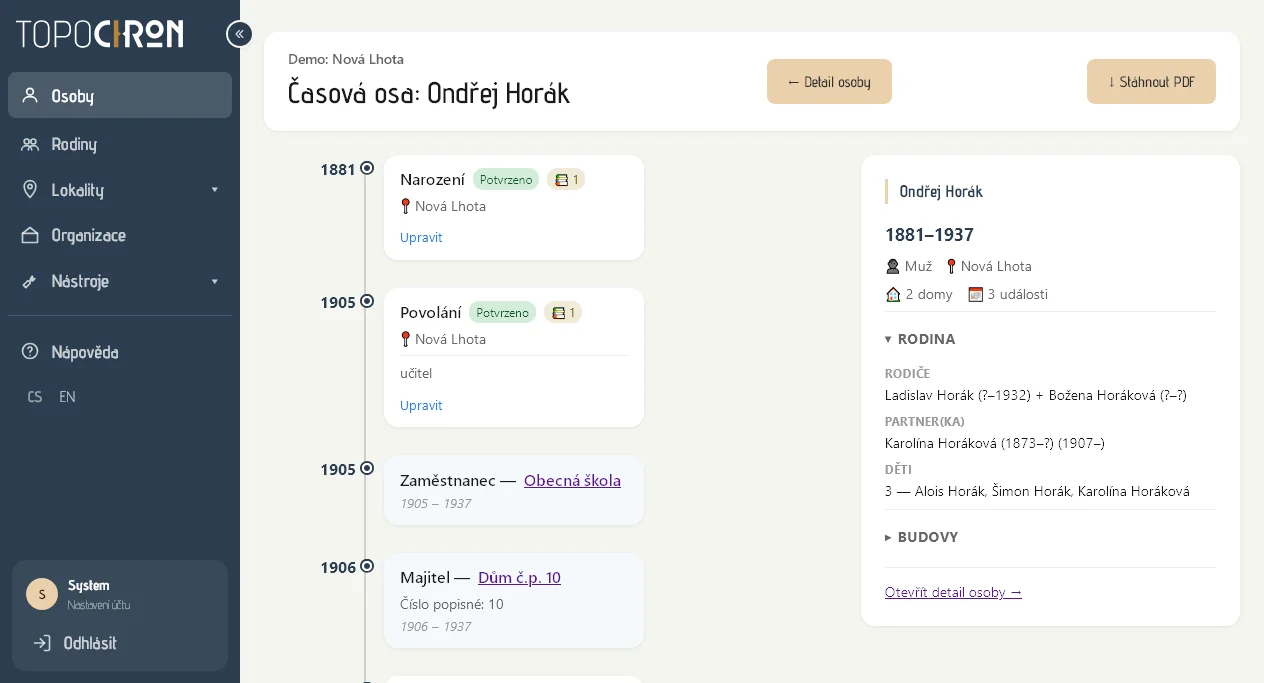
Timeline
A chronology of the life of a person, family, house or an entire village.
Map
A modern map, aerial imagery and historical military surveys as a base layer — with layers of buildings, places, events and organizations.
House history
Who lived in the house, owned it or worked there.
Village and association history
Buildings, organizations and events over time.
Relationship graph
Connections between people, houses and associations at a glance.
For institutions
Do you run a village, museum or association?
We will show you the app tailored to your data — with no commitment. We also offer installation on your own server, data migration and training.
Arrange an online demoComparison
Why is Topochron different?
| Typical genealogy software | Topochron | |
|---|---|---|
| Family tree | ✓ | ✓ |
| GEDCOM | ✓ | ✓ |
| House history | — | ✓ |
| Village history | — | ✓ |
| Import a village from RÚIAN | — | ✓ |
| Organizations / associations | — | ✓ |
| Map | — | ✓ |
| AI import of parish registers | — | ✓ |
| Timeline | partly | ✓ |
| Source citations | ✓ | ✓ |
| Export to open standards (Dublin Core, LIDO, IIIF) | — | ✓ |
| One database of people, houses and organizations | — | ✓ |
What Topochron can do
Built on simplicity and precision
AI import of parish registers
Photograph a digitized parish register, have the record transcribed with ChatGPT, Claude or Gemini, and simply review and save the resulting JSON. It saves time during archival research, but it is not required — everything can also be entered by hand.
Family trees and relationships
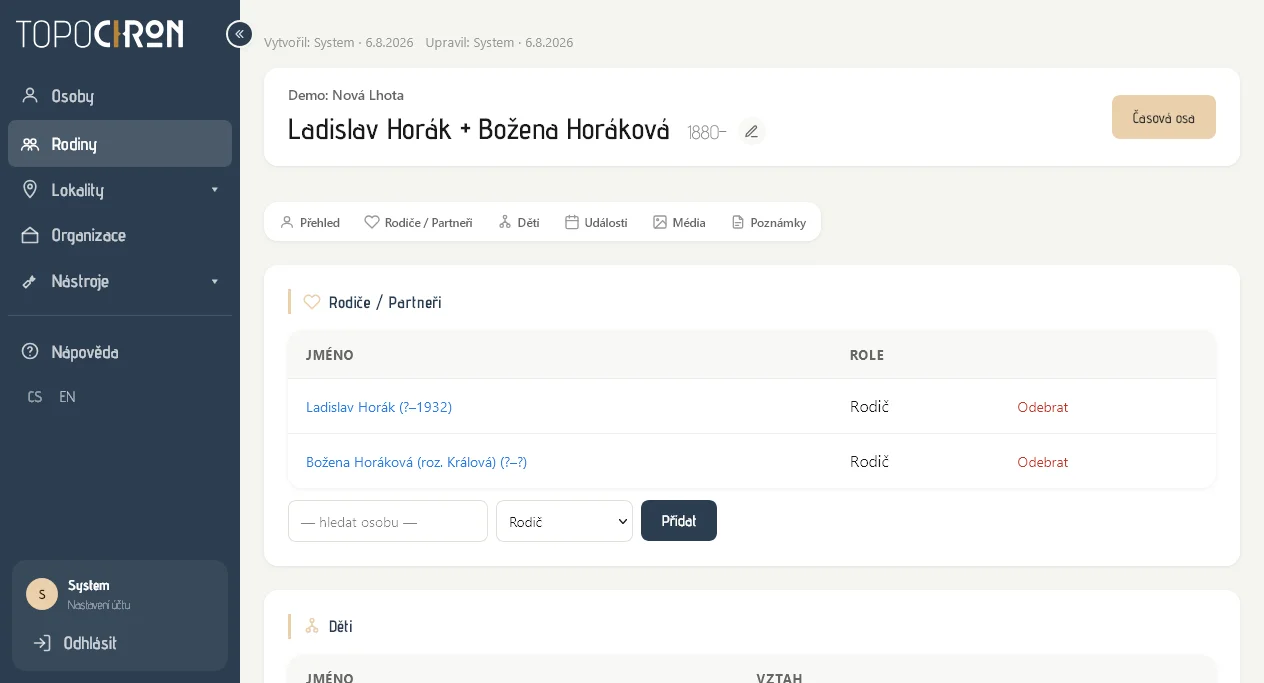
An interactive tree of ancestors and descendants, a graph of family ties, and a clear view of partnerships, children and parents on the person detail.
History of houses and associations
Most genealogy programs handle only people and families. Topochron also records houses, farmsteads, associations, companies and whole villages — each with its own history and timeline.
Map and timelines
Switch between a modern map, aerial imagery and historical military surveys, toggle layers of buildings, places, events and organizations as well as cadastral boundaries. Larger numbers of buildings cluster automatically, so the map stays readable even for a whole village.
Sources and citations
Every piece of family history can be backed by a source — archive, book, page and a note tied to a specific citation of an archival source.
Import a village from RÚIAN
With a single click, load official data about a village — its parts, streets and hundreds of buildings straight from the public RÚIAN registry, including coordinates and descriptive and registration numbers. There is no need to create the village house by house.
Interoperability
Open standards
The Topochron Repository is designed with interoperability in mind, using international standards common in museums, archives and digital collections.
Dublin Core
Standardized metadata for describing digital objects. It makes basic information about an object easy to exchange between different systems.
LIDO 1.1
A metadata standard designed primarily for museums and cultural heritage. It allows information about objects to be exported in a form suitable for museum catalogues and other cultural systems.
IIIF Presentation 3.0
A standard for presenting digital images and their metadata. It makes images and their metadata available through a Manifest and usable in compatible IIIF viewers.
Open standards without locking your data into one system
Open standards make it easier to reuse and exchange data. The Topochron Repository is not a closed system — digital objects and their metadata can be reused in other systems.
The process
From parish register to family tree in four steps
-
1
Photograph the parish register
A scan from a regional archive (SOA / eBadatelna) or another digitized archive.
-
2
Let AI transcribe it
Use the ready-made prompt in ChatGPT, Claude or Gemini and get structured JSON.
-
3
Paste and review
Paste the JSON into the app, fix any inaccuracies and link the people.
-
4
Save
A historical event and the people are created — without needless duplicates in the family tree.
AI import is just the faster route — people, families and events can of course also be entered by hand, without a parish register.
Frequently asked questions
What you might want to know
Do I have to use AI import of parish registers?
No. AI import is just a faster way to transcribe parish registers — people, families and events can be entered by hand at any time.
What types of data does Topochron record?
People, families, historic buildings, organizations, events and archival sources with citations — all connected in one genealogy database.
Can I share my research with other people?
Yes, through shared collections — you invite a collaborator with the role of editor (full access) or viewer (read only).
Which AI tools can I use to transcribe parish registers?
Any of them — ChatGPT, Claude, Gemini. No specific tool is required or preferred.
How can I try Topochron?
Fill in the contact form. We will send you access to the demo version, or arrange a short walkthrough.
Do I have to enter every house in the village by hand?
No — just pick a village and Topochron automatically loads its parts, streets and buildings, including coordinates and house numbers, from the public RÚIAN registry. You then only add the history — who lived in the house, who owned it, what happened there.
Who it is for
Topochron is for you too, if you are…
Genealogists and family historians
You are building a family tree and want fewer duplicates and more context.
Museums
You record people, buildings and collections tied to a region.
Villages and chroniclers
You record the history of the village, its houses and associations in one database — and you load the basic structure (streets, houses, house numbers) from RÚIAN in a moment, not by hand.
Parishes
You work with parish registers and want to link them to real people and families.
Owners of historic houses
You want to document who lived in the house, owned it and worked there.
Historians and researchers
You do archival research and need sources and citations in one place.
Start uncovering the history of your family, house or village
Genealogy, house and village history and archival research in one database.
Sign inContact
Try the demo
Want to try the demo, have a question, or looking for a solution for a village or institution? Write to us and we will get back to you.